
Tackling Invasive Alien Species
Did you know that invasive alien species are one of the major drivers of biodiversity loss worldwide, competing with, preying on and spreading disease to native wildlife? EAZA Members and the EAZA Executive Office respond on several fronts: hands-on projects that detect and remove invasive species, engagement in European policy and information tools, and input into global strategies.
November 2026 Conservation Snapshot
EAZA Members are putting work into detecting invasive species, reducing their impact and raising awareness. The following examples show the different ways Members are helping to protect native wildlife.
Detection dogs against the American mink in Spain
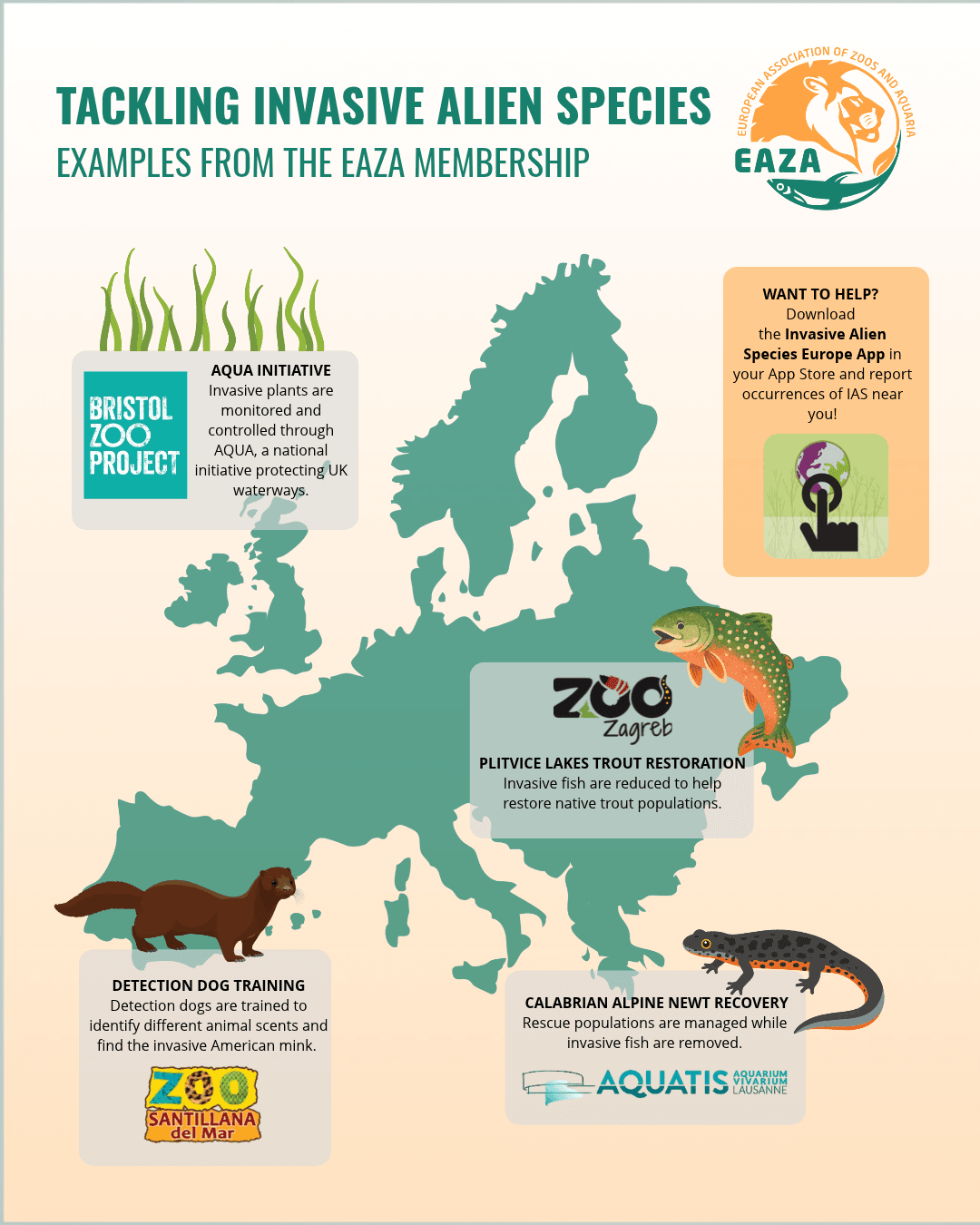
Santillana Zoo collaborated with Odor Naturae to train dogs to detect invasive species. In this case the invasive species is the American mink (Neovison vison), and finding its populations in the wild supports the conservation of the European mink (Mustela lutreola). Santillana Zoo contributed samples from its own animals and from other mustelids, helping the dogs learn to tell the different scents apart.
Protecting the Calabrian Alpine newt in Italy
This project supported by Aquatis Vivarium (Switzerland) focuses on mitigating the impact caused by the introduction of invasive alien fish species in three lakes of the Special Area of Conservation (SAC) in the north of the Catena Costiera, Calabria. The main objective is to remove or mitigate the impact of alien fish on the highly imperilled endemic Calabrian alpine newt (Ichthyosaura alpestris inexpectata), in parallel with managing ex situ populations for release. The project is in collaboration with the Istituto per la BioEconomia, University of L’Aquila and Museo Regionale di Scienze Naturali in Italy.
Restoring native trout in Plitvice Lakes National Park, Croatia
Zagreb Zoo is supporting fieldwork to reduce the population of non-native fish, a prerequisite for restoring the native trout (Salmo trutta) population. Five non-native fish species, including Oncorhynchus mykiss and Scardinius erythrophthalmus, seriously threaten native species in the waterways of Plitvice Lakes National Park. They disrupt habitat conditions and compete for resources, threatening the survival of native species. Partners in this project are the University of Zagreb and AQUATIKA.
Controlling invasive plants and raising awareness in the UK
Bristol Zoo Project, in collaboration with DEFRA, launched an initiative to monitor and control invasive plants in Southwest England and raise awareness of the threats they pose. It has since grown into a UK-wide movement to protect rivers, lakes, canals and harbours from invasive non-native species: The AQUA (Aquatic Quality Award).
Coming soon! IUCN SSC Centre for Species Survival in Italy
A new IUCN SSC Centre for Species Survival on Invasive Alien Species data provision and communications will be hosted by Bioparco Rome, to support implementation of Global Biodiversity Framework Target 6 through data sharing, expertise exchange and strategic action on invasive species.
EU Invasive Alien Species Regulation
The European Union recognises that tackling invasive alien species is essential to protecting native biodiversity. Its The EU Invasive Alien Species (IAS) Regulation entered into force in 2014 and provides as a framework to prevent IAS, their introduction and spread, and to minimise and mitigate their impact. The EAZA EU Policy Office works with policymakers to ensure that measures to protect native biodiversity do not undermine our efforts to conserve threatened species from outside Europe. One example is the Vietnamese sika deer (Cervus nippon pseudaxis). Extinct in the wild, this subspecies is cared for by more than 30 European zoos through an EAZA Ex Situ Programme (EEP). Sika deer have recently been added to the EU’s list of invasive alien species, creating new challenges for this conservation work. The EAZA EU Policy Office is helping Members understand and follow the new rules.
Tools and funding available
Information tools and funding can help conservation organisations, including EAZA Members, turn plans into practical action.
The European Alien Species Information Network (EASIN) is one useful starting point. Developed by the European Commission’s Joint Research Centre, it brings together a catalogue of alien species, maps and species factsheets, alongside a citizen science app for reporting sightings. These resources support the EU’s work on invasive alien species and can help projects build a clearer picture of the threats they need to address.
For projects ready to act, the European Invasive Alien Species Rapid-Response Fund offers practical support. Co-funded by the EU and run by IUCN Save Our Species, it provides fast-track grants of €10,000 - €50,000 for projects lasting up to 12 months. It supports early detection and rapid eradication of invasive plants, animals and macroalgae before they spread, with technical guidance and opportunities to exchange experience helping projects develop and progress. Conservation organisations, research institutions and public authorities operating in the EU can apply. EAZA Members and partners with suitable projects are encouraged to explore the current call, which closes on 10 February 2027.
This European action sits within a wider global effort. IUCN’s new "Union Strategy on Invasive Alien Species”, calls for expansion and better access to data, standards knowledge and tools, stronger capacity building with governments, the private sector and the civil society, more scaling up action on the ground for early detection and rapid response – including and sustainable funding. Presented at CBD COP17 in October 2026, the IUCN strategy supports implementation of Global Biodiversity Framework Target 6 and highlights prevention and pathway management as key measures for reducing the introduction and impacts of invasive alien species.
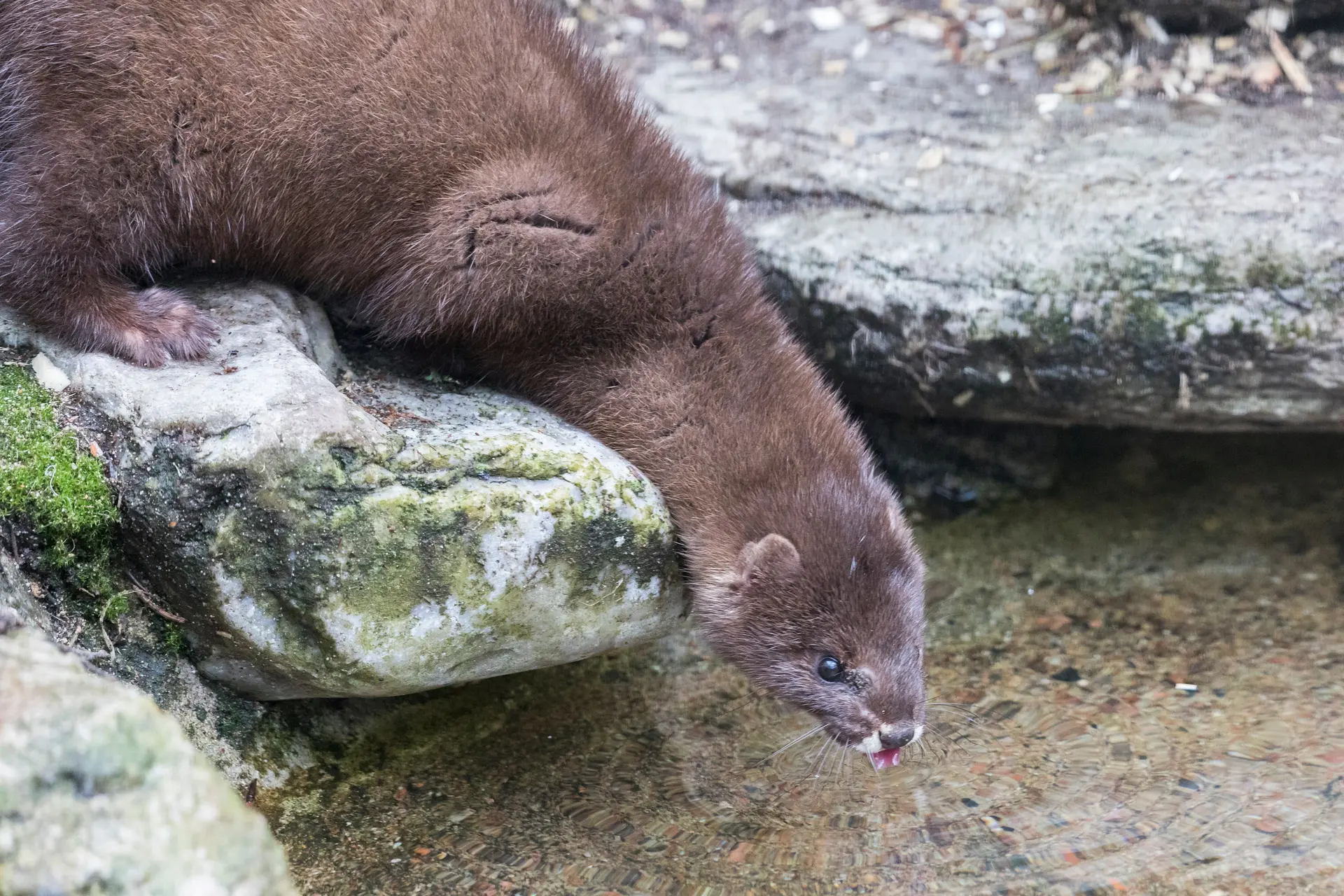
Banner picture: European mink drinking (Mustela lutreola) © Marko Junttila, Ranua Zoo