
Chimpanzee
(Pan troglodytes)
EEP Coordinator: Jana Pluhackova, Ostrava Zoo
Vice coordinators: Arun Idoe, Burger´s Zoo and Laetitia Latorre, Beauval Zoo
EEP page - Chimpanzee
Coordinators and Partners
- Like other EEPs, also the Chimpanzee EEP works together with partners to strengthen population management in human care, combat wildlife trafficking and support thriving animal populations in the wild. In 2024, EAZA signed an agreement with Animal Advocacy and Protection (AAP) for species-specific cooperation and sharing of expertise to benefit chimpanzees.















What are the EEP roles?

| Conservation education | Keeping chimpanzees in enclosures and social group compositions that meet the needs of the taxon and encourage behaviours typical for the species, provides an opportunity to engage the public with education and awareness about chimpanzees andconservation. The EEP is able to directly contribute to the conservation of the species by raising awareness on the need for sustainable consumption of specific goods at specific times (e.g. education on mobile phone recycling, and sustainable palm oil), as well as by providing educational messages on the threats that the chimpanzee is facing in situ (including the pet trade) and its reputation. Even though this contribution may be modest in the larger conservation strategy for chimpanzees, it is still thought to be significant. Raising awareness on chimpanzees and the threats to the species in the wild is furthermore thought to be important for the fundraising role. |
| Fundraising | The Great Ape TAG encourages EEP participants to carry out fundraising activities to support chimpanzee conservation. This includes contributing to funds for selected projects for the chimpanzee in general and/or for specific chimpanzee (sub)species. The TAG and EEP are willing to provide support in identifying appropriate projects. Conservation research: The Great Ape TAG encourages chimpanzee holders to proactively contribute to research activities that provide a direct benefit to chimpanzee conservation and welfare. It is thought that studies done with the ex situ population can provide valuable information, and research activities are already well-established and ongoing. |
| Conservation research | The Great Ape TAG encourages chimpanzee holders to proactively contribute to research activities that provide a direct benefit to chimpanzee conservation and welfare. It is thought that studies done with the ex situ population can provide valuable information, and research activities are already well-established and ongoing. |
| Capacity building | The Great Ape TAG considers capacity building an important component of the EEP population, so relevant knowledge and expertise on chimpanzee husbandry and research can be shared with to those who can benefit from it in other regions, including ex situprogrammes, facilities and rescue centres. High husbandry standards will not only be promoted in EAZA, but also in other regions, for any institution keeping chimpanzees. |
| Insurance | The Great Ape TAG wants to work towards a sustainable ex situpopulation for the Western and Central chimpanzee in EAZA. It is recommended that the EEP population functions as an insurance population, for in case individuals or genetic variation ever need to be reintroduced into the wild. This would require a genetically and demographically stable and behaviourally competent ex situ population that is actively managed. Even though reintroductions are generally thought to be challenging, the future is difficult to predict and in case of unforeseen catastrophes, reintroductions may be needed. The Great Ape TAG considers the benefit of acting as an insurance population high, as the Western chimpanzee population in situ is Critically Endangered and declining, Central chimpanzee population in situ is Endangered and declining. The feasibility of fulfilling this insurance role will depend on overcoming the reproductive and behavioural challenges, and strong engagement of the holders will be needed. |

| Conservation education | Keeping chimpanzees in enclosures and social group compositions that meet the needs of the taxon and encourage behaviours typical for the species, provides an opportunity to engage the public with education and awareness about chimpanzees andconservation. For the indirect conservation education role, the chimpanzee can be used to help their counterparts in the wild and convey broader conservation messages. As a charismatic species with which people can easily empathise, the chimpanzee has great potential for engaging visitors with strong conservation messages and addressing their conscience. Many important messages could be relevant here, including encouraging behavioural change of resource consumers and putting pressures to companies, making people aware of certified ecotourism, etc. As such, this EEP is thought to be able to provide a considerable contribution to conservation. |
| Advocacy | Considering the status and charisma of the chimpanzee, the Great Ape TAG feels the EEP is well-suited to encourage lobbying activities using the chimpanzee as an umbrella species. The EEP has connections to the right people to identify topics for which lobbying is quickly needed to achieve a certain conservation outcome. |

| Biological research | Keeping chimpanzees in enclosures and social group compositions that meet the needs of the taxon and encourage behaviours typical for the species, provides an opportunity to engage the public with education and awareness about chimpanzees and conservation. For the non-conservation education role, the chimpanzee can be used to convey broader messages, such as general biological education and (re)connecting people to nature, for many reasons, including the species’ close relatedness (and differences) to humans. |
| Basic and applied research | The Great Ape TAG encourages chimpanzee holders to proactively contribute to research activities on chimpanzee husbandry and welfare, as well as on cognition, behaviour and morphology related to human evolution. Research contacts are already well established and ongoing. |
EEP in numbers
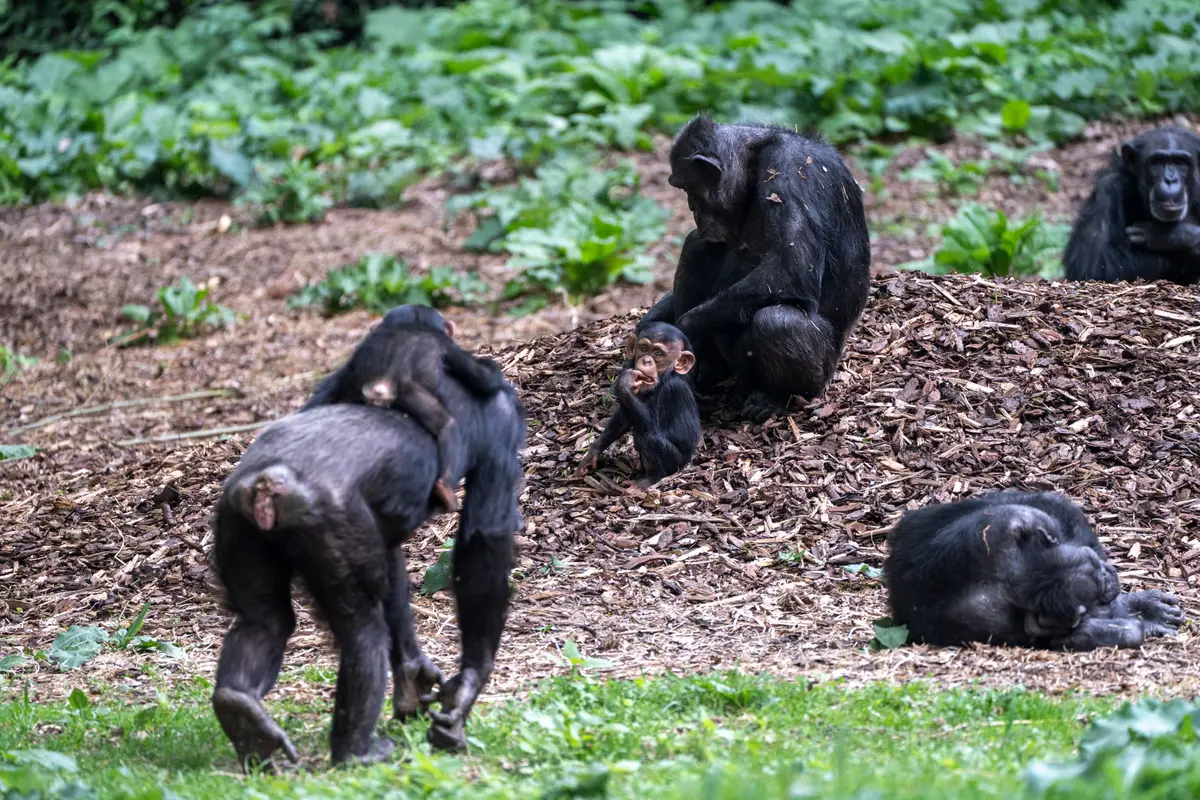
In September 2025 the Chimpanzee EEP included:
- 679 animals
The EEP consists of:
Pan troglodytes verus in total: 274 (100.174)
Pan troglodytes troglodytes in total: 44 (15.28.1)
Pan troglodytes hybrid in total: 281 (104.177)


Programme highlights
- - The EEP has a private facebook group for holders and fans of chimpanzees. There is also a page on Instagram that people can follow.