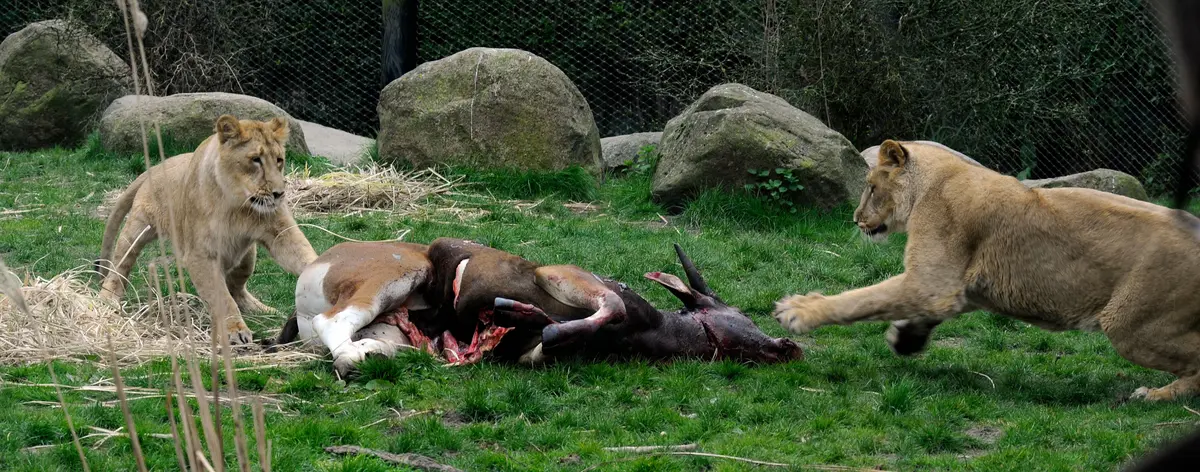

Asiatic lion
(Panthera leo persica)
EEP Coordinator: Jos Hartog, Diergaarde Blijdorp
EEP page - Asiatic lion
Coordinators and Partners



What are the EEP roles?

| Insurance | Considering the status of the Asiatic lion in the wild, i.e. it is listed as Endangered by the IUCN Red List with a small population size in range, the EAZA Felid TAG would like to work towards an ex situ insurance population for the Asiatic lion in EAZA. A lot of work is needed in order to accomplish this, i.e. in order to establish a genetically and demographically sustainable, and behaviourally competent ex situ population in EAZA, work is needed amongst others on molecular genetics and obtaining new founders and holders (space). Nonetheless, considering the status of the species in the wild, this is something that the TAG would like to actively work towards as this is considered highly beneficial. No reintroductions are planned for the near future, and the TAG wants to focus on establishing a stable, genetically diverse population first. |
| Research and training | The EAZA Felid TAG encourages cooperative (in situ and ex situ) research and training activities to benefit the in situ and ex situ populations of Asiatic lions. Research activities could, amongst others, focus on investigating Asiatic lion behaviour and genetics, as well as veterinary and health topics. Furthermore, local training to set up training and testing facilities in range are considered beneficial for Asiatic lion conservation. |

| Education | Keeping Asiatic lions ex situ in attractive exhibits where the animals are able to display most of their natural behaviours (obviously limiting/controlling natural intraspecific behaviours that would threaten individual welfare) provides the opportunity to engage the public with conservation education and awareness about lions, their biology and habitat, the special status of the Asiatic lion as a subspecies, the subspecies’ highly threatened status, and its conservation needs. This may positively influence Asiatic lion conservation. |
| Fundraising | When keeping Asiatic lions, it is recommended by the Felid TAG to carry out fundraising activities for recommended in situ projects for the Asiatic lion in range. The TAG/Coordinator is working towards establishing contact with a conservation in situ (India) project, and hopes to have an action plan by 2024. Nevertheless, EEP participants are encouraged to contribute and explore further potential projects, as this could be highly beneficial for species conservation. Good communication between institutions and the Coordinator is important to explore/identify projects to support. Furthermore, the IUCN SSC Cat Specialist Group has provided relevant contacts to the TAG for future discussions on project(s) support. |

| Exhibit | The Asiatic lion is a charismatic, attractive and highly popular species, which is of cultural value and can serve as a symbol for conservation. As such, the Asiatic lion has an important exhibit role. |
EEP in numbers
In October 2025, the Asian lion EEP included:
- 115 animals
- in 42 institutions.



Programme highlights
- Diergaarde Blijdorp and Utrecht University initiated a PhD project on neurological health conditions and nutritional vitamin deficiencies in the Asiatic lion in 2024.