

Saving Songbirds Together
From Europe to the other side of the world, songbirds are faced with various threats to their existence. At the CITES CoP20, EAZA representatives are working to ensure the birds under serious threat from trade receive the protection they urgently need. Songbird conservation has been the focus of many EAZA Members’ efforts in the past years.
December 2025 Conservation Snapshot
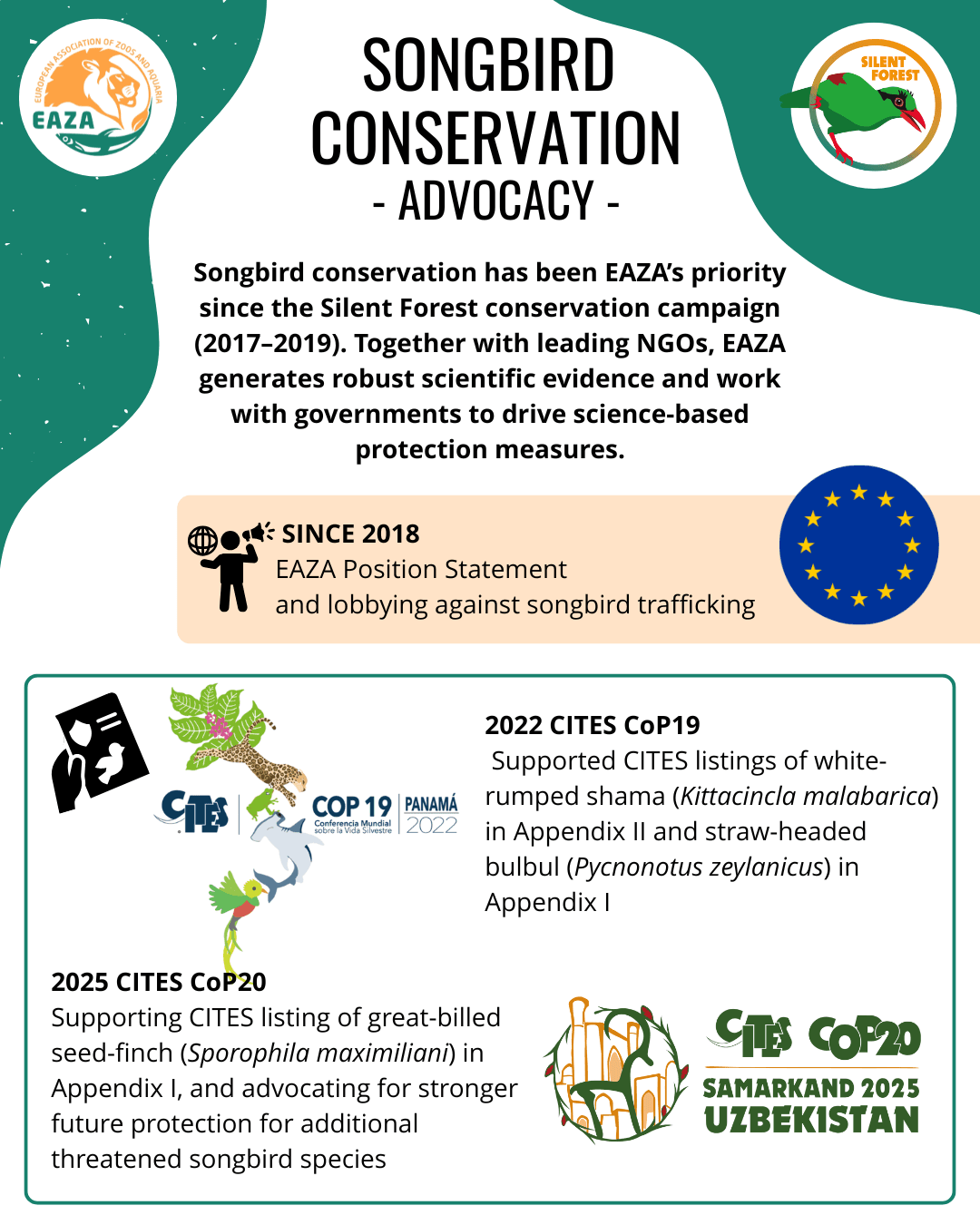
The Convention on the International Trade of Endangered Species of Wild Flora and Fauna (CITES) Conference of the Parties (CoP) 20 is taking place in Samarkand, Uzbekistan (24 November – 5 December 2025). This international agreement regulates trade in wild animals and plants to ensure their survival, using Appendices I–III to set different levels of protection. Countries enforce these rules through national laws and permits.
EAZA, as an official observer, is attending to provide expertise and represent the interests of our community. Among the many issues on the agenda, the substantial international trade in wild-caught songbirds is a matter of particular importance to EAZA at this CoP, given the legacy of the EAZA Conservation Campaign Silent Forest. Although songbirds make up 60% of all bird species and dominate the global bird trade, only 1.4% are listed under CITES.
Proposals under review include listing the Great-billed seed-finch in Appendix I and several other Sporophila species in Appendix II. EAZA is also co-hosting a side event on 2 December, “The Global Songbird Crisis: Trade, Impacts and Regulation,” to highlight the worldwide scope of this issue and to call for continued and increased engagement.


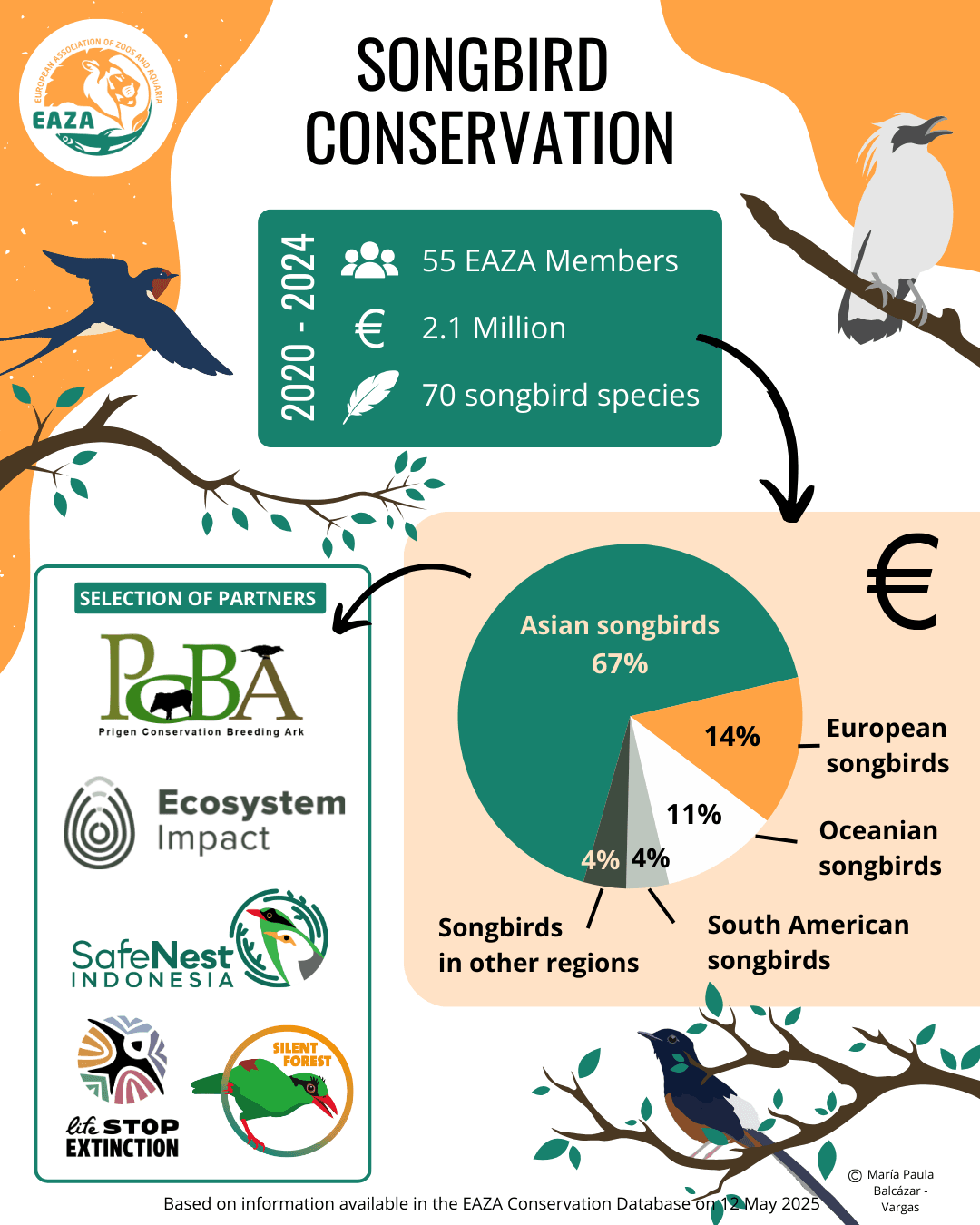
EAZA Members have shown a strong and growing commitment to songbird conservation, particularly in Asia. Over the past five years, 55 EAZA Members have contributed €2.1 million to conservation efforts benefiting at least 70 songbird species!
Asia
67% of this support
was directed toward Asian songbird initiatives, with a strong focus on in range
conservation breeding programmes. Many of these efforts were launched or
expanded through the Silent Forest Campaign and are carried out in close
collaboration with partners such as the Prigen Conservation Breeding Ark and
the Cikananga Conservation Breeding Centre.
Europe
About 14% of the recorded support went towards songbird conservation efforts in Europe. These efforts target
species such as choughs, sparrows, and swallows, and include actions ranging
from habitat restoration and nest-box provision to direct support for the Committee
Against Bird Slaughter (CABS).
CABS plays a crucial role in tackling illegal poaching and overexploitation of migratory (song)birds across Europe in collaboration with environmental authorities, police, regulators, and customs services. They intervene where hunters, trappers, or traders violate conservation laws, helping to safeguard vulnerable bird populations.
Oceania
More than 11% of the
recorded support went to efforts in Oceania. One of the main receivers is the Fatu Hiva Monarch project, launched in 2022 by EAZA Member Auckland Zoo (New Zealand) in partnership with the Polynesian Ornithological
Society Manu.
The Critically Endangered Fatu Hiva Monarch, a flycatcher threatened by invasive predators and avian malaria, benefits from Auckland Zoo’s expertise in ex situ breeding and veterinary care, with additional support from Copenhagen Zoo, Zoos Victoria, and other partners. The project also implements essential field monitoring, predator-control programmes, and measures to mitigate avian malaria, all of which are vital to the species’ long-term survival.
Picture credits
Banner: Red-billed chough (Pyrrhocorax pyrrhocorax) © Durrell Wildlife Conservation Trust. From left to right: Great-billed seed-finch (Sporophila maximiliani) © Mato Grosso; Rufous-fronted laughingthrush (Garrulax rufifrons) © Cikananga conservation breeding centre; Fatu Hiva monarch (Pomarea whitneyi) © Benjamin Ignace
Blog post by Merel Zimmermann, 1 December 2025